Why the Fastest Teams Are the Ones Who Test
December 5th, 2025
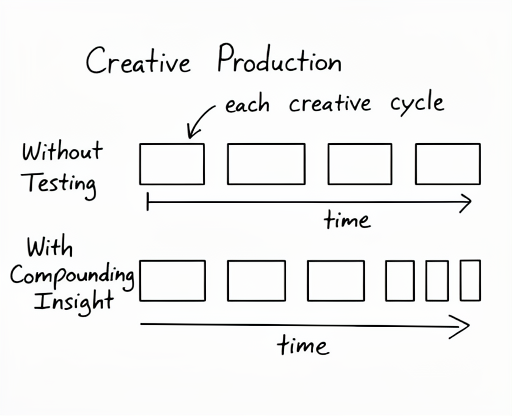
When the pressure is on, testing feels like a luxury you can't afford. But the fastest creative teams are the ones who know what works from experimentation. Testing doesn't slow you down, it compounds your speed over time.
When Q4 hits or a major campaign launches, the instinct is clear: "We need to move fast. We don't have time for testing."
It's a reasonable instinct. Budgets are high, stakes are higher, and there's pressure to execute. Testing feels like a detour when you need a straight line to results.
But here's what the fastest teams have discovered: speed and understanding aren't opposing forces. The teams that move quickest are the ones who know what works, because they tested.
The Speed Paradox
Without systematic testing, every creative refresh starts from scratch. You're guessing what might work, launching, waiting to see results, then guessing again. With creative fatigue requiring new ads every 7-21 days, that's 17-52 cycles per year of educated guesses.
With compounding insights from experimentation, each cycle builds on the last. By month 6, you're not asking "what should we try?" You already know what's likely to work based on patterns across all your previous tests.
The paradox: taking time to learn actually saves time. The teams who tested during last Q4 moved faster this Q4.
Three Time Horizons for Speed
Short-term (Days): Apply What You Know
If you've been testing, you already have insights to act on. Launch confidently based on what your experiments have shown. No committee meetings debating creative direction. You have data-backed patterns showing which hooks, themes, and visual elements drive results for your brand.
This is the immediate speed benefit: you create better content faster when you're not starting from zero.
Medium-term (Weeks): Quick-Iterating Elements
Not all tests take weeks. Text overlays, color adjustments, and crops can be refined over days. During high-stakes periods, focus testing on these quick-iterating elements.
Compare this to the alternative: guess, launch, start over. Which is actually faster at producing great content?
Long-term (Months): Your Best Learning Opportunity
Here's a counterintuitive truth: peak periods with high traffic provide the strongest signals from experiments. The high volume means clearer results, faster statistical confidence, and more reliable patterns.
Established Direction Means Faster Execution
Once a pattern is validated through a few cycles, it becomes established creative direction. The team can act on it confidently without discussion or re-testing each time.
This is where speed really compounds. You're not debating "should we try transformation hooks or problem-focused hooks?" anymore. You know. You execute. You move on to testing the next layer of refinement.
The Real Time Cost
Consider what's actually faster:
Without systematic testing:
- Phase 1: Brainstorm creative ideas (debate, meetings, opinions)
- Phase 2: Produce a wide range of creative (guessing what might work)
- Phase 3: Launch and hope some work well
With compounding insights:
- Phase 1: Check patterns from past experiments, brief creative team with data-backed direction
- Phase 2: Produce focused creative (high-confidence variants)
- Phase 3: Launch with systematic test structure
The second approach isn't slower. It's faster, and each cycle gets faster still.
Conclusion
The "we need speed right now" objection treats testing as the opposite of action. In reality, teams that test systematically move faster because they're not reinventing creative direction every 7-21 days.
Each test builds understanding. The fastest teams are the ones who've been testing all along, so when speed matters most, they already know what works.