Your Creative Process Can Validate Patterns
December 5th, 2025
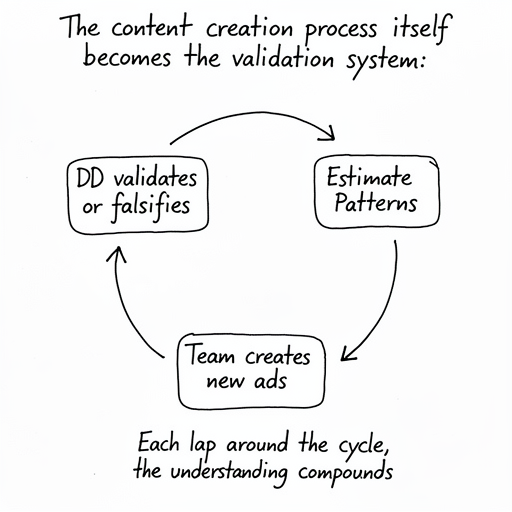
Asking 'how do we validate these patterns?' is exactly the right question. The answer is simpler than you might expect: your existing creative workflow validates patterns naturally, each time you create new ads guided by insights.
"These patterns are interesting, let's put together a system to test and validate them." is a reasonable thought when reviewing test results.
Here's the good news: you don't need to build a separate system. Your content creation process itself is a great validation system.
The Headlights Metaphor
Think of testing insights as what you can see in your headlights. You're driving at night, and the headlights reveal the road ahead. Based on patterns across multiple experiments, you can see strong signals about what's working. You have a sense of where the road is, and where the bushes start. But the view is limited to what creative has been tested so far.
To get more confident about a direction, you travel along it. You test more in that direction. The headlights reveal more road.
This isn't a limitation of experimentation. It's how knowledge works. You learn by acting, observing, and refining.
The Validation Cycle
When you use findings to guide content creation, validation happens automatically:
- DD surfaces patterns from experiments
- Team creates new ads guided by those insights
- DD validates or falsifies by measuring the new ads
- Understanding sharpens as patterns strengthen or get refined
- Team creates new ads with that sharper understanding
- Repeat
Each cycle through this loop either confirms a pattern or reveals its boundaries. Using the insights in creative is the validation infrastructure.
A Concrete Example
Say DD surfaces a pattern: purple hues are performing well. The data shows ads emphasizing these colors consistently beat ads where the product is pink or yellow.
Your team leans into this for the next round of creative. Those new ads are the validation test. DD measures them against each other and against earlier content.
If purple continues to win across different products, audiences, and formats, the insight strengthens. If they work for some products but not others, you've discovered the boundaries. If they don't work, you've falsified that idea and you now look harder at the ads that performed well before for something else they had in common. Either way, you've learned something important without building any new system.
Speed Benefit
This approach doesn't just validate. It accelerates.
Once a pattern is validated through a few cycles, it becomes established creative direction. The team can act on it confidently without discussion or re-testing each time.
You're not debating "should we try purple" anymore. You know. You execute. You move on to testing the next layer of refinement.
The validation cycle creates compounding confidence:
- Cycle 1: Initial pattern detected
- Cycle 2: Pattern holds with new creative
- Cycle 3: Boundaries discovered
- Cycle 4+: Established direction, team executes without hesitation
Why Separate Validation Systems Fail
Teams sometimes try to build formal validation processes: hypothesis review meetings, dedicated test-and-learn budgets, sign-off workflows for acting on insights.
These usually create friction without adding value. They slow down the creative cycle, which reduces how often patterns get tested. Fewer cycles means weaker validation, not stronger.
The teams that move fastest just act. They use the insight, create new ads, and let the results speak. If the pattern doesn't hold, they'll see it in the next experiment. That's real validation, not process theater.
Your Team Already Has the System
If your team creates new ads regularly, whether every week or every month, you already have a validation system. The only question is whether you're using it.
When insights guide what you create next, each creative cycle validates or refines those insights.
The validation infrastructure exists. It's your creative process. Use the headlights you already have.