How does Deciding Data work?
October 29th, 2026
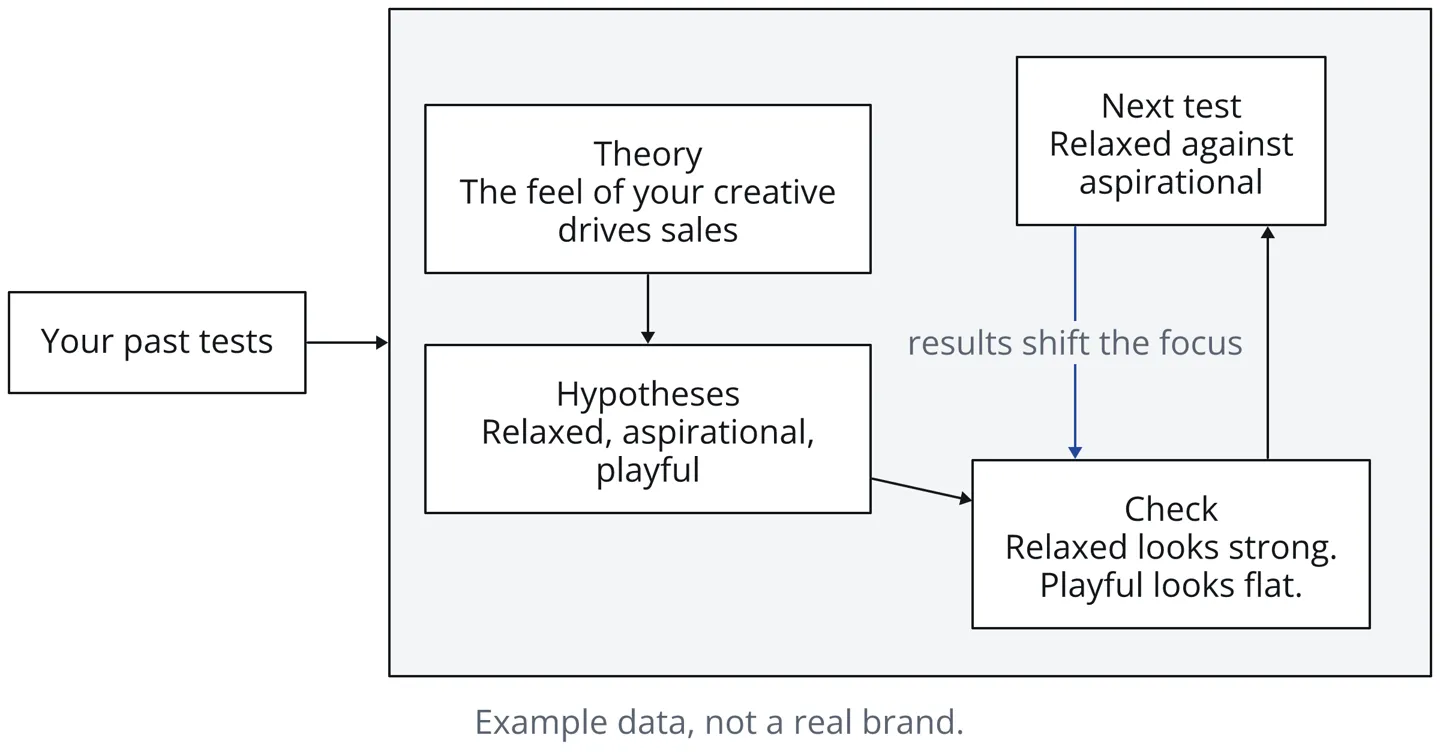
Each test sharpens the check, and the next test goes where it's worth the most.
We turn your past tests into ideas about your customers, then help you test the most promising one. Each test adds to what your team knows.
We start by reading your past tests
We read past tests from your ad and email accounts: what each variant said and showed, and all of its results. Reading is all this step needs. We don't touch your editor or your creative, and in email we never write to your account.
Then we run a loop of four steps
Theory. We start from a broad idea that creative teams already believe, such as "the feel of your creative drives sales." It's a starting guess, not a finding, and the rest of the loop exists to test it.
Hypotheses. We split the theory into specific claims, one for each way your creative's feel actually varies. Say your ads and emails range from relaxed to tense, from aspirational to practical, and from playful to serious. That gives three claims: a relaxed feel sells more, aspirational sells more than practical, and a playful tone sells more.
Check. We score every past variant against each claim and see how its results line up. In the example, relaxed looks strong, because the more relaxed variants sold more across many tests. Playful looks flat, with no clear difference either way. Aspirational hasn't varied enough to say, because nearly every past variant sat on the aspirational side.
Next test. We consider how much each idea could still improve results and how unsure we are about it. We help you see which tests are worth the most. Let's say that's relaxed against aspirational.
Results feed back. Each test sharpens our understanding. Focus shifts toward the ideas still worth testing, and what's settled accumulates.
What you get from Deciding Data
You get two things, ready to share with your team, your agency, and your AI agents:
- What you know so far: which ideas matter, how big each effect is, and how sure we are.
- The next test, and why it's the one worth running.
In the example, the first is a relaxed feel that sells more, with its size and how sure we are of it. The second is the test of relaxed against aspirational, with the reason it comes next. We don't write the creative for that test. Your team, your agency, or your AI tools write it, and we help them understand how your audience responds to their work.
One caution: tests don't get shorter
Tests don't get shorter as you learn. A test still needs enough sends to show a difference, early or late. What rises is the floor under every new campaign. Each round of creative starts from more of what works, so even an ordinary campaign begins from a higher place than the one before it.
Your tests stop being a pile of old reports. They become a few clear ideas about what your customers respond to, each one checked against what happened, with every new test aimed where it can teach you the most.