The World Makes the Choice
July 17th, 2026
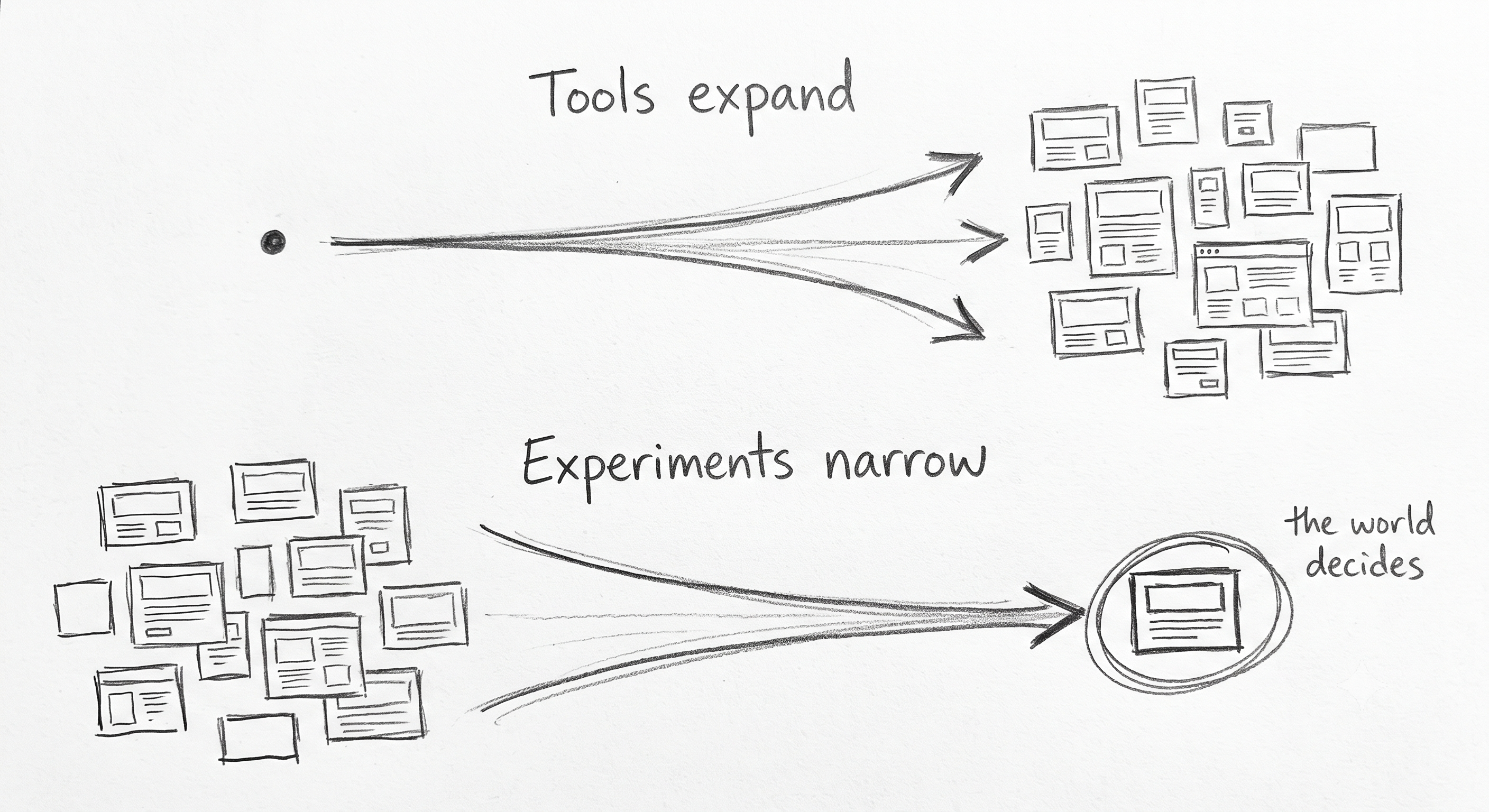
Cheaper tools multiply your creative options; experiments narrow them to the ones that works best.
Faster, cheaper tools mean more ways to build an email, a paid ad, or a landing page: more knobs to turn, more variations to try. But abundance is not progress, and more drafts do not tell you which one works. Experiments do the reverse work. They narrow the pile of options to an evidence-backed answer, because in the end the world, not your tools, decides what wins.
Good Marketing Is Hard to Build
Strong creative is the single biggest lever you have on performance, and it is genuinely hard to get right. When Nielsen studied what drives results, creative turned out to be the element with the largest impact on sales lift, ahead of targeting, reach, or the rest of the media plan.
The channels differ, but the problem rhymes. An email, a paid ad, and a landing page all live or die on whether the creative connects. And there is no formula that tells you in advance which idea will connect, so building something good has always meant the same thing: guess, ship, and see what happens.
Better Tools Produce More Choice
Creation tools keep getting faster and cheaper, and they hand you more of everything: more knobs to turn, more variations to try, more stories to tell, all in less time. That abundance compounds across every channel at once:
- A dozen subject lines for the email
- A dozen hooks for the paid ad
- A dozen layouts for the landing page
Yes, AI is one of these tools, but it is not the only one. Templates, editing suites, and cheaper production all push in the same direction. The result is the same everywhere: you can now generate far more options than before.
Here is the catch. Abundance is not the same as progress. More drafts do not tell you which draft works, they just grow the pile you have to sort through. Every new option is one more decision you now own, so the tools that were supposed to save you time quietly hand you more work.
Experiments Do the Reverse
Where creation tools multiply options, experiments narrow them. An experiment takes the pile of possibilities and asks one simple question: which of these work?
The same discipline applies everywhere you make creative:
- Test the subject lines in email
- Test the hooks in your paid ads
- Test the layouts on your site
What you get back is not a menu of angles to choose from. It is an answer, a narrowing toward what works best and a signal for what to try next. That is the scarce and valuable part: an option backed by evidence, not a longer list of options.
They Tell You the Hard Truths of the World
Experiments do not care about your tools. They do not care that a draft only recently became possible to make, or that another one has worked for years. They care about real behavior, the clicks, sign-ups, and purchases your customers actually give you.
Those results are bossy. They tell you what is true whether you like it or not, and that is exactly the point. In a world drowning in options, the constraint is the value. Let the tools multiply the choices, and let the experiments, and the world, make the choice.
Takeaway
Creation is getting cheaper and noisier while deciding is getting more valuable. The winning approach is not more options, it is a defensible answer about what works and what to try next.
- Use the new tools to explore widely. Generate the variations across email, ads, and your site.
- Use experiments to commit. Let real behavior narrow the pile to what works.
- Let the world make the choice. It is the one critic whose opinion actually counts.