Why not just let the platform learn?
October 29th, 2026
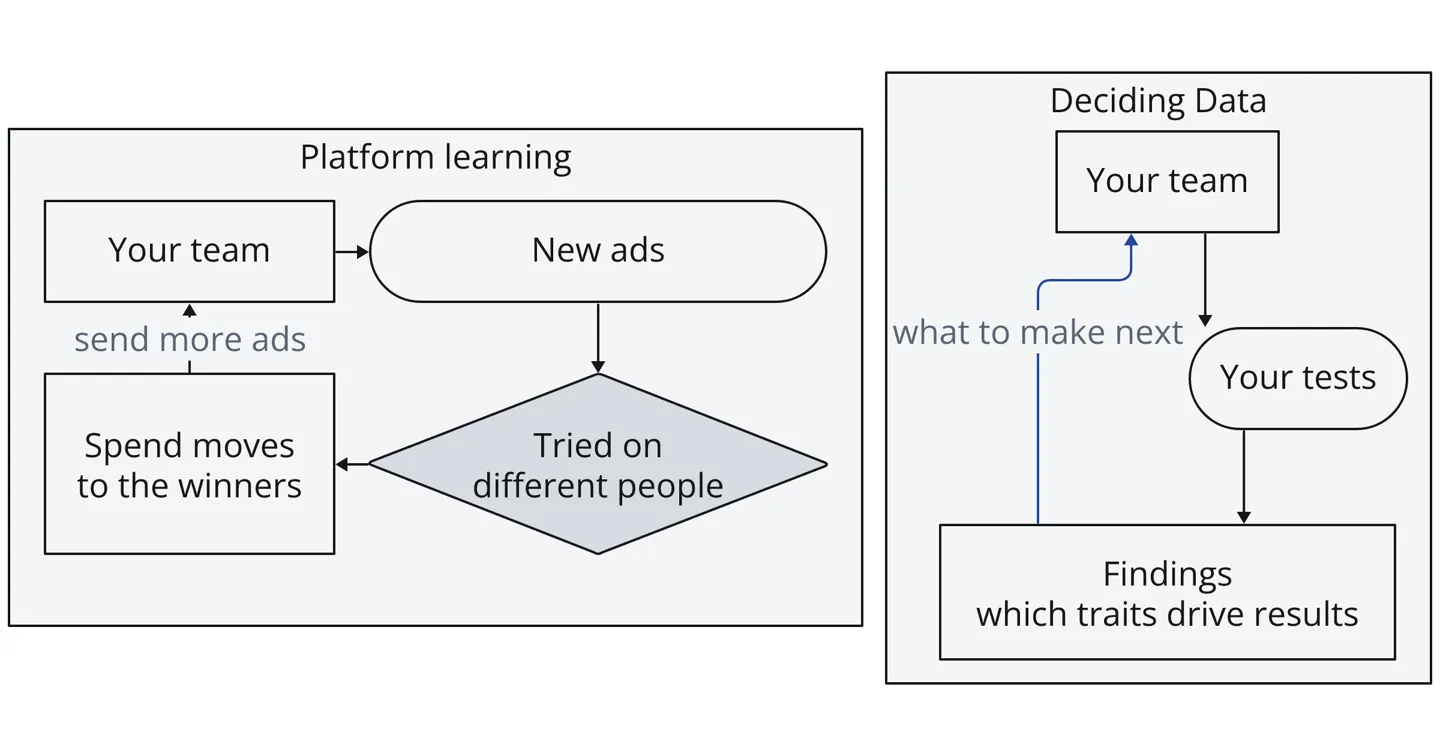
Both loops run on your tests. Only one sends back what it learned.
Meta's tests teach Meta's algorithm. Ours teach you.
Keep letting the platform learn
Platforms like Meta run automated experiments on your ads all the time. When you upload new creative, Meta tries each ad on different people and moves spend. That usually improves this week's results, because it answers the platform's own question: which ad to show to whom, right now.
Email has the same shape. Klaviyo's A/B test sends two versions to part of your list, picks the one that did better, and sends it to everyone else. It picks which to show now.
Let's take an example. Say you upload six ads for a summer launch. Three have a relaxed feel: a slow morning, an easy voice, no countdown. Three feel urgent: bold type, "ends Sunday," a ticking clock. Within a week, Meta has moved most of your spend to two of the urgent ads, and your results improve.
The platform keeps what it learned
Those experiments aren't built to tell you anything. Meta never saw "urgent" as a trait. It saw that two particular ads earned more than the other four, and it shifted spend to those two. It doesn't need to know why to do its job, so it never looks for the reason: its question is what to show, not why it works. Your report shows six ads and what each one spent. It never says that your customers respond to urgency.
When the ads wear out, you start over with a fresh batch, and nothing from the last round carries forward. The next brief may well ask for a relaxed feel again, because nobody told your team otherwise.
Your question is different from the platform's. The platform asks which ad to show. You ask what the next batch of creative should say, and the platform's experiments were never meant to answer that.
We do the work to understand your tests
We look at your A/B tests and do the work to understand them. First we review your brand and your ads to work out what might matter: the selling point, the offer, the image, the feel. Each of those is an idea about your customers, not yet a finding. Then we describe every ad against those ideas, so the six summer ads become six sets of traits, and "urgent" is one of them.
Next we line those traits up against results across every test, not one test at a time. A single launch where urgent beat relaxed is interesting. But if the same trait does well across many tests, it becomes something your team can plan around.
Finally we tell you which traits drive results, how sure we are about each one, and which test would settle what's still unclear. For the summer launch, that might read: an urgent feel sells more, we are fairly sure of it, and the next test should check whether it holds when there is no discount behind the deadline.
The two work together
The platform makes the most of the ads you give it. We help you give it better ads.
In the example, your team takes "urgency sells" into the next brief and writes six new urgent ads, each urgent in a different way. Meta then does what it does best and finds the right people for each of the six.
What Meta learns from your ads is rented. It stays in Meta's system, and it starts again with every new batch. What your team learns is its own, and it grows with every test you run.